
Predictive Maintenances IoT
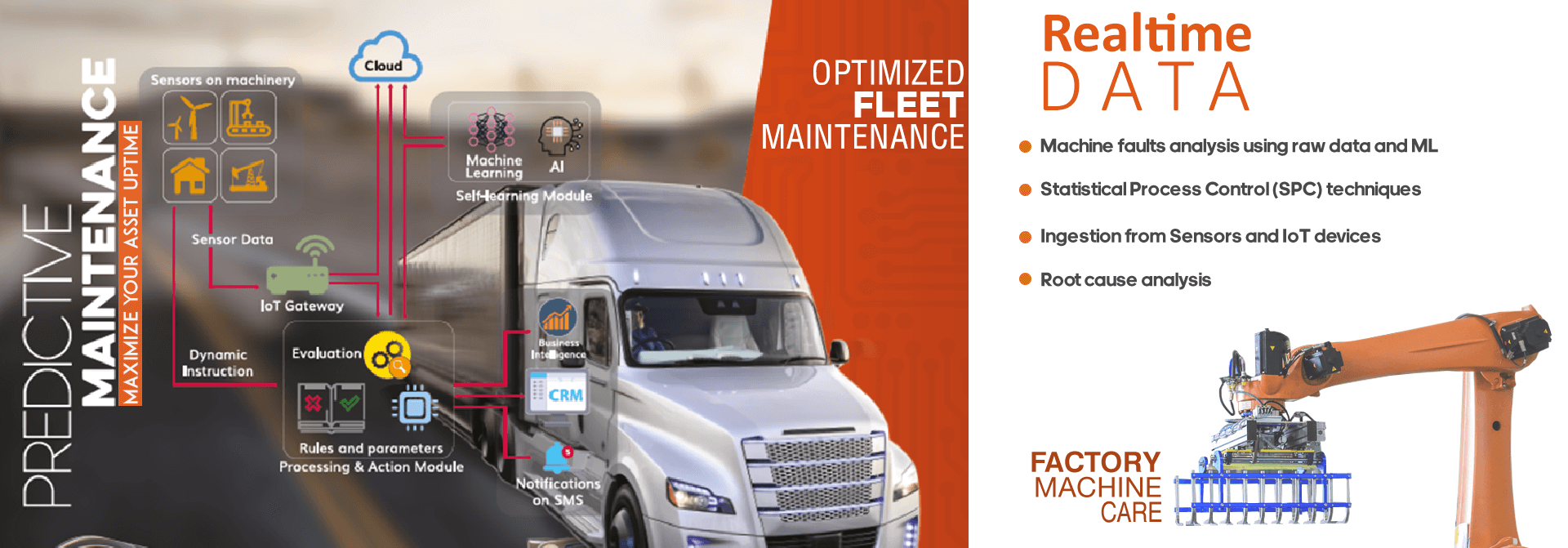
The condition-monitoring equipment used by the Predictive Maintenance platform is used to analyze an asset's performance in real-time. The Internet of Things is a critical component in this process (IoT). Different assets and systems may connect, collaborate, exchange, analyze, and act on data thanks to the Internet of Things. Sensors are used in the Internet of Things to collect data, interpret it, and highlight any areas that require attention. Vibration analysis, oil analysis, thermal imaging, and equipment observation are some instances of Predictive Maintenance IoT utilizing sensors. Choosing the right approach for condition monitoring is a crucial decision that should be made in collaboration with equipment manufacturers and our condition monitoring specialists.
WHY PREDICTIVE MAINTENANCE
- Predictive Maintenance would help reduce downtime by a significant amount.
- It would increase the life cycle of assets by providing pre-determined maintenance alerts to reduce actual asset damage.
- It would help increase machine efficiency by making sure assets are functioning in nominal conditions.
- Resource Management of spare parts/machine parts would become easier with pre-active maintenance alerts.
- Helps improve the supply chain by making efficient maintenance checks.
- Proactive maintenance means all maintenance checks happen proactively avoiding redundancies and complete failures.
How does Faststream Technologies IoT-based predictive maintenance work?
For predictive maintenance to be carried out on an industrial asset, the following base components are used by Faststream Technologies:
1. Sensors – data-collecting sensors installed in the physical product or machine.
2. Data communication – the communication system that allows data to securely flow between the monitored asset and the central datastore
3. Central data store – the central data hub in which asset data (from OT systems), and business data (from IT systems) are stored, processed, and analyzed; either on-premise or on-cloud.
4. Predictive analytics – Predictive analytics algorithms are applied to the aggregated data to recognize patterns and generate insights in the form of dashboards and alerts
5. Root cause analysis – data analysis tools used by maintenance and process engineers to investigate the insights and determine the corrective action to be performed
Difference between preventive and predictive maintenance
Manufacturers have been carrying out different forms of preventive and predictive maintenance for years. Understanding the difference between them, however, is critical with the emergence of Industry 4.0.
Preventive maintenance depends on visual inspections, followed by routine asset monitoring that provides limited, objective information about the condition of the machine or system. In this process, manufacturers regularly maintain and repair a machine to prevent failure.
On the other hand, Predictive Maintenance is data-driven and relies on analytics insights for maintenance and repairs ahead of disruptions in production.
The benefits of predictive maintenance with Faststream Technologies:
- Reduced maintenance time
- Increased efficiency
- New revenue streams
- Improved customer satisfaction
- Competitive advantage
How are Companies using our IoT-based predictive maintenance tools?
Organizations are implementing predictive maintenance analytics in a range of ways, from targeted solutions for a single machine part, to factory-wide deployments for increasing OEE throughout the production line. For machine and parts manufacturers, a relatively common predictive maintenance use case is monitoring and analyzing the condition of a motor to get alerts about its productivity levels, power consumption, health status, and internal wear. Another powerful use case of predictive maintenance is minimizing production defects and reducing waste. Often referred to as Quality 4.0, such implementations can predict when the number of defective products is likely to exceed a threshold percentage and provide the root causes for the expected failure. Manufacturers are also turning to predictive maintenance for Factory 4.0, or a connected factory, by installing sensors in machines, workstations, and other designated sites such as the HVAC, security cameras, or worker equipment, to predict issues across the factory floor.
Get Solutions of IoT Based Predictive Maintenances, connect with us at info@faststreamtech.com
Read More about IoT Solutions
- Digital Twin Solutions
- IoT Security with Blockchain
- Smart Wearable Devices
- Oil and Gas Industry

